APS Levels Explained: Officer and Executive

Public Service Jobs Overview

If you’ve never worked in Government before, the seniority system and Australian Public Service (APS) work level standards can be a little bit mystifying. Don’t worry, you’ll get used to it fast.

There are two good news points to make at the outset:

1. The structure is pretty much the same across the Commonwealth and all States and Territories, and


2.The structure does loosely mirror what you would expect to see in large private companies, albeit with a different corporate objective (i.e. no profit motive).

APS Levels Explained

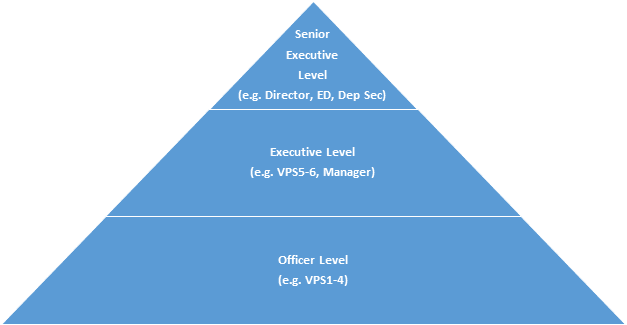
At its simplest, the hierarchy of Government looks like a pyramid, with the majority of staff at officer level ‘doing the work’, with two levels of management above:


The example APS classifications above correlate to the levels of seniority in the Australian Public Service (APS), but you will see similar levels and classifications in all Governments in Australia.


For example, the levels for the Victorian Public Service look like this:


APS Level Guide

Generally speaking, advancing within your section of the pyramid (i.e. from level 3 to level 4, or from Executive Level 1 to Executive Level 2) is easier to achieve that advancing to the next rung on the career pyramid (if you’ll excuse the mixed metaphor).


The reason for this is that these three distinct levels is assumed to carry with it a progressively greater level of managerial or corporate responsibility.


Of course, this is not a hard-and-fast rule. There are plenty of APS4s who manage staff, and plenty of subject matter experts at the Senior Executive Level who do not. However, it is a useful framework within which to view the differences between these levels.


Generally, a person advancing from the first layer to the second would start supervising one or two people. When they are promoted to the EL1 level, they will be responsible for running a whole section. Should they wish to advance to the SES, they would be responsible for a branch, comprising several sections and potentially dozens of officers.

I’m coming in from the Private Sector – What APS Levels Should I Target?

This is a difficult question, and of course every person’s situation is different. If your only experience is in hospitality, Government work will present a steep learning curve, and you would want to give yourself an opportunity to excel – so enter at a level where expected knowledge of government processes is lower. If you are the CEO of BHP and used to managing thousands of people, you should probably run your own Department.


Pay scales can help – but are not always a useful method of calculating where you fit, either. We have seen equal numbers of under-qualified and over-qualified candidates land a job in the public service, only to end up stressed and disillusioned, or bored out of their brains. The best advice we can give here is to talk to people – in the organisation, in the team (there is always a contact officer for every job, for a reason!) and try to feel out how good a fit you are. If you think you can handle it, aim higher! After all, you’re not the one doing the assessing, so throw your hat in the ring, be honest, and you might get a pleasant surprise.

Complete job application bundles (CV + Selection Criteria) from $449

CV + Selection Criteria

Complete job application bundles (CV + Selection Criteria) from $449

competing-priorities

APS Classification Levels


Now, having said all that, here is a rough approximation of the equivalent levels, by a few professions:


Public Servant Office Administrator Academic Lawyer Teacher
APS 1-2 Intern Paralegal Placement
APS 3-4 Administrator Research Assistant Junior Associate Classroom Teacher
APS 5APS 6 Senior Administrator PhD Candidate Associate Snr Teacher
EL1 Office Manager Post-Doc Researcher Senior Associate 1-2 Leading Teacher
EL2 Director Senior Lecturer Senior Associate 3-4 Deputy Principal
SES CEO Dean Partner Principal


It’s important to realise that Government is a different world to the private sector. If you’ve worked in any large organisation, a lot of the process and bureaucracy will already be familiar to you. If you haven’t, give yourself the time and space you need to get familiarised with the public service culture. This is especially important if you are going to be managing people.


A small investment, made early, will reap dividends in the future.

Queensland Government Jobs and Pay Scales

Introduction

The Queensland Public Service is one of the largest employers in the state, with around 241,768.87 (March 2022) employees across various departments and agencies. The maximum number of jobs in Queensland is in Brisbane, with 51% of jobs in the city.

Working in the Queensland Government can be an attractive prospect for many individuals seeking stable employment, competitive pay and benefits, and opportunities for professional growth and development. However, navigating the job application process, understanding the Code of Conduct, and deciphering the pay scale can be overwhelming.

Selection Criteria Review (Graduate)

Detailed assessment of your written statement starting at $99

User persona

Overview of the Queensland Public Service

a. Government Jobs in Queensland

The Queensland Government offers a range of full-time, part-time, and casual positions across different job roles and industries. Some of the most common job roles in the Queensland Public Service include:

  • Administration
  • Customer service
  • Education
  • Finance
  • Human resources
  • Information technology
  • Legal services
  • Marketing and communications
  • Policy and research
  • Project management

b. Applying for Queensland Government Jobs

The Queensland Government job application process can be complex, but it is important to understand and follow the steps to increase your chances of success. Before applying for any government job, you should familiarise yourself with the job description and ensure that you meet the minimum qualifications and requirements. You must also submit a resume and a cover letter highlighting your relevant experience and qualifications.

c. Tips for Applying for Government Jobs in Queensland

When applying for government jobs in Queensland, it is important to be prepared and follow a few tips to increase your chances of success. These include:

  • Ensure that your resume and cover letter are tailored to the job description and highlight your relevant experience and qualifications.
  • Check for spelling and grammatical errors before submitting your application.
  • Provide clear and concise responses to any selection criteria or statement of claims.
  • Follow all application instructions, including the submission deadline and required documents. Some applications may require to submit an expression of interest (EOI).
  • Keep track of your applications and follow up if necessary.

Queensland Government Job Application

To apply for a Queensland Government job, you will need to submit your application online through the Queensland Government’s Smart Jobs and Careers website. This website provides information about job openings, the application process, and the status of your application. When submitting your application, ensure that you have included all required documents and have followed the application instructions.

a. Code of Conduct for the Queensland Public Service

As a government employee in Queensland, it’s important to understand the code of conduct that governs your behaviour in the workplace. The Queensland Public Service Code of Conduct outlines the ethical and professional standards that all public service employees must adhere to.

  • Integrity
  • Commitment to the public good
  • Respect for the law
  • Respect for persons
  • Responsiveness
  • Ethical behaviour
  • Sustainability

b. Overview of the Code of Conduct

The Code of Conduct outlines the values and principles that guide the behaviour of public servants, including integrity, impartiality, accountability, and respect for human rights. It also outlines the responsibilities of public servants, including acting in the public interest, providing honest and impartial advice, and using public resources responsibly.

c. Importance of Adhering to the Code of Conduct

Adhering to the Code of Conduct is essential for maintaining public trust and confidence in the Queensland public service. It also ensures that public servants act ethically and responsibly and that the government is able to deliver high-quality services to Queenslanders.

d. Education Queensland Code of Conduct

The Education Queensland Code of Conduct outlines the following standards for employees:

  • Professionalism
  • Duty of care
  • Respectful relationships
  • Confidentiality
  • Managing conflicts of interest
  • Responsible use of resources
  • Compliance with laws and policies

Breaching the Education Queensland Code of Conduct can result in disciplinary action, including termination of employment.

Queensland Government Pay Scale

The pay scale for government jobs in Queensland is determined by a variety of factors, including the level of experience and qualifications required for the position, as well as the job responsibilities and the location of the job. Generally, the pay scale for a government job in Queensland ranges from approximately $50,000 to $200,000 per annum.

a. Explanation of the Queensland Government Pay Scale

The Queensland Government pay scale is divided into different levels based on job classification, with each level having a set minimum and maximum salary range. The minimum and maximum salary ranges are set by the Queensland Government Wages Policy and are reviewed regularly to ensure that they are competitive with other employers in the public and private sectors.

b. Factors that Influence Queensland Government Pay Scale

Several factors influence the Queensland Government pay scale, including job classification level, experience, qualifications, and performance. For example, employees at higher job classification levels typically receive higher salaries than those at lower levels. Similarly, employees with more experience or higher qualifications may receive higher salaries than those with less experience or lower qualifications.

Queensland Government Job Classification Levels

The Queensland Government job classification levels are divided into several levels, with each level representing a range of roles and responsibilities. The levels range from AO1 to SES Band 3, with each level having a set minimum and maximum salary range. Higher job classification levels typically require more experience and qualifications and have greater responsibilities and decision-making authority.

Types of Government Jobs in Queensland

There are several types of government jobs in Queensland, including federal government jobs, state government jobs, and graduate jobs.

a. Federal Government Jobs in Queensland

Federal government jobs in Queensland are available in a wide range of fields, including health, education, law enforcement, and public administration. These jobs are typically available through the Australian Public Service jobs website, which provides information about job openings, application requirements, and the recruitment process.

b. Queensland State Government Jobs

Queensland state government jobs are available in a range of fields, including health, education, law enforcement, and public administration. These jobs are typically advertised on the Queensland Government’s Smart Jobs and Careers website, which provides information about job openings, application requirements, and the recruitment process.

c. Queensland Government Graduate Jobs

Queensland Government graduate jobs are available in a range of fields, including accounting, engineering, and law. These jobs are typically advertised on the Queensland Government’s Graduate Portal website, which provides information about job openings, application requirements, and the recruitment process.

Benefits of Queensland Government Jobs

Working in the Queensland Government has several benefits, including job security, competitive pay and benefits, and opportunities for professional growth and development.

a. Job Security

Working in the Queensland Government provides job security, as the public service is a stable and secure employer. This is especially important during times of economic uncertainty, as public servants are less likely to experience job loss or unemployment.

b. Competitive Pay and Benefits

The Queensland Government offers competitive pay and benefits, including generous superannuation, paid parental leave, and flexible working arrangements. The government also provides opportunities for professional development and career advancement, including training programs and mentoring.

c. Opportunities for Professional Growth and Development

Working in the Queensland Government provides opportunities for professional growth and development, as public servants are exposed to a diverse range of roles and responsibilities. This can lead to increased job satisfaction and career advancement opportunities.

How to Get a Government Job in Queensland

To get a government job in Queensland, you will need to meet the minimum qualifications and requirements for the job and submit a strong application that highlights your relevant experience and qualifications

a. Qualifications Required for Government Jobs in Queensland

The qualifications required for government jobs in Queensland vary depending on the job classification level and the field of work. However, most government jobs require a minimum level of education and relevant experience.

b. Where to Find Job Openings in the Queensland Public Service

Job openings in the Queensland public service can be found on the Smart Jobs and Careers website, as well as through recruitment agencies and job boards. It is important to regularly check these sources for new job openings and to ensure that you meet the minimum qualifications

c. Tips for Increasing Your Chances of Getting a Government Job in  Queensland

Here are some tips for increasing your chances of getting a government job in Queensland:

  • Tailor your application to the job: Read the job description and tailor your application to highlight your relevant experience and qualifications.
  • Address the selection criteria: Address each selection criterion in your application, and provide examples of how you meet each criterion.
  • Provide evidence of your skills and experience: Provide evidence of your skills and experience, such as certificates, qualifications, or references.
  • Prepare for the interview: Prepare for the interview by researching the organisation and practising your responses to common interview questions.
  • Network: Network with current government employees and attend job fairs and recruitment events to increase your chances of getting a job.

Conclusion

Working in the Queensland Government can be a rewarding and fulfilling career choice, offering job security, competitive pay and benefits, and opportunities for professional growth and development. To get a government job in Queensland, you will need to meet the minimum qualifications and requirements for the job and submit a strong application that highlights your relevant experience and qualifications.

Cover Letters for Public Service Careers in Australia

Introduction

When it comes to applying for a government job, your cover letter can make or break your chances of landing the position. It is your first opportunity to make a strong impression on the hiring manager (which might be in HR or your new boss) and showcase your skills and qualifications. In this article, we will discuss how to write an effective cover letter for government jobs, including tips and best practices.

Components of Cover Letter

A cover letter typically includes the following components:

Contact Information

This includes your:

  • Full name
  • Address
  • Phone number
  • Email address
  • The date
  • The contact information of the employer or hiring manager you are addressing.

Salutation

This is the greeting at the beginning of your letter. You should address the recipient by name if possible (if it’s not on the position description, see what you can find out via the Org Chart or LinkedIn), or, if absolutely necessary, use a generic greeting such as:

  • “Dear Hiring Manager” 
  • “To Whom It May Concern.”

 Letter/Selection Writing services​.

Professional writing services to help you stand out in government job applications with tailored, high-quality responses

soft-skills-in-government-applications

Introduction

In the opening paragraph, you should briefly introduce yourself and state the position you are applying for. You might also mention how you learned about the job opening or why you are interested in the company.

Body

The body of your letter should explain why you are a good fit for the job. You can highlight your relevant skills and experience, and provide specific examples of your accomplishments that demonstrate your qualifications for the position.

Closing

In the closing paragraph, you should express your enthusiasm for the job and thank the employer for considering your application. You might also include a sentence about following up on your application, such as “I look forward to the opportunity to discuss my suitability with you further.”

Signature

End the letter with a professional closing, such as “Sincerely” or “Kind regards,” followed by your full name and signature.

Integrated Leadership System (ILS): An Explainer

Introduction

Public servants play a crucial role in the functioning of Australia’s government, delivering essential services to the public, and shaping the country’s policies and regulations. However, to be effective in their roles, public servants need to possess strong leadership skills and capabilities. This is where the Integrated Leadership System (ILS) comes in, as it provides a framework for identifying and developing leadership skills across all levels of the Australian Public Service (APS), the “APS ILS”.

The APS Integrated Leadership System

The APS Integrated Leadership System is a comprehensive framework that outlines the core leadership skills and capabilities required of all public servants across the APS – the ILS Capabilities. The system is designed to support the development of leaders at all levels, from entry-level positions to senior executive roles. It is managed by the Australian Public Service Commission (APSC), which is responsible for overseeing the implementation of the system and ensuring that it aligns with the government’s strategic goals and priorities.

The Public Sector Capability Framework (or APS Capability Framework)

The APS Integrated Leadership System is built upon the Public Sector Capability Framework, which provides a foundation for the identification and development of core skills and capabilities required of all public servants. The framework outlines the following core capabilities:

    • Shapes strategic thinking
    • Achieves results
    • Cultivates productive working relationships
    • Exemplifies personal drive and integrity
    • Communicates with influence
    • Demonstrates accountability and sound judgments

These capabilities are relevant to all public servants, regardless of their level or specific job function. They provide a foundation for the development of leadership skills and are used as a basis for assessing performance and potential in the context of the Integrated Leadership System.


You can use the ILS to ensure that you are targeting your job application to the correct level. 

EL2 is the highest level of leadership within the APS Integrated Leadership System. Employees at this level are responsible for leading and managing complex projects and programs, and for providing strategic direction to their teams and the wider APS.

Some of the key competencies and behaviours that are expected at this level include:

    • Strategic Thinking– being able to think critically and strategically, identify opportunities and risks, and develop and implement plans that align with organisational goals and objectives.
    • Leadership– demonstrating the ability to inspire and motivate others, provide direction and guidance, and manage change effectively.
    • Communication– being able to communicate clearly and effectively with colleagues, stakeholders and clients at all levels of the organisation, and to influence and negotiate to achieve desired outcomes.
    • Results Focus– being able to manage complex projects, set priorities and deliver results that meet or exceed expectations.
    • Building Capability– developing the capability of others, providing constructive feedback and coaching, and sharing knowledge and expertise to build the capability of the team and the organisation.
    • Continuous Learning– seeking out new learning opportunities, reflecting on experiences and applying new skills and knowledge in the workplace.
    • Customer Focus– understanding and meeting the needs of internal and external clients and stakeholders, and continuously improving service delivery.
    • Teamwork– working collaboratively with others, valuing and respecting diversity, and contributing to a positive work environment.

EL1 is the second-highest level of leadership within the APS Integrated Leadership System. Employees at this level are responsible for leading and managing teams, and for implementing strategies and policies within their areas of responsibility.

  • Strategic Thinking – being able to think critically and strategically, identify opportunities and risks, and develop and implement plans that align with organisational goals and objectives.
  • Leadership – demonstrating the ability to inspire and motivate others, provide direction and guidance, and manage change effectively.
  • Communication – being able to communicate clearly and effectively with colleagues, stakeholders and clients at all levels of the organisation, and to influence and negotiate to achieve desired outcomes.
  • Results Focus – being able to manage complex projects, set priorities and deliver results that meet or exceed expectations.
  • Building Capability – developing the capability of others, providing constructive feedback and coaching, and sharing knowledge and expertise to build the capability of the team and the organisation.
  • Continuous Learning – seeking out new learning opportunities, reflecting on experiences and applying new skills and knowledge in the workplace.
  • Customer Focus – understanding and meeting the needs of internal and external clients and stakeholders, and continuously improving service delivery.
  • Teamwork – working collaboratively with others, valuing and respecting diversity, and contributing to a positive work environment.

APS 6 is a mid-level leadership position within the APS Integrated Leadership System. Employees at this level are responsible for managing teams and projects, and for contributing to the development of policies and strategies.

Some of the key competencies and behaviours that are expected at this level include:

    • Strategic Thinking– being able to think critically and strategically, identify opportunities and risks, and develop and implement plans that align with organisational goals and objectives.
    • Leadership– demonstrating the ability to inspire and motivate others, provide direction and guidance, and manage change effectively.
    • Communication– being able to communicate clearly and effectively with colleagues, stakeholders and clients at all levels of the organisation, and to influence and negotiate to achieve desired outcomes.
    • Results Focus– being able to manage complex projects, set priorities and deliver results that meet or exceed expectations.
    • Building Capability– developing the capability of others, providing constructive feedback and coaching, and sharing knowledge and expertise to build the capability of the team and the organisation.
    • Continuous Learning– seeking out new learning opportunities, reflecting on experiences and applying new skills and knowledge in the workplace.
    • Customer Focus– understanding and meeting the needs of internal and external clients and stakeholders, and continuously improving service delivery.
    • Teamwork– working collaboratively with others, valuing and respecting diversity, and contributing to a positive work environment.

APS 5 is a lower-level leadership position within the APS Integrated Leadership System. Employees at this level are responsible for carrying out operational tasks and contributing to the development of policies and strategies within their areas of responsibility.

    • Strategic Thinking– being able to analyse complex information, identify trends and patterns, and develop and implement strategies that align with organisational goals and objectives.
    • Leadership– demonstrating the ability to inspire, motivate and guide others, and to lead by example.
    • Communication– being able to communicate clearly and effectively with colleagues, stakeholders and clients at all levels of the organisation.
    • Results Focus– being able to manage projects, set priorities and deliver results that meet or exceed expectations.
    • Building Capability– supporting the development of others, providing constructive feedback and coaching, and sharing knowledge and expertise to build the capability of the team and the organisation.
    • Continuous Learning– seeking out new learning opportunities, reflecting on experiences and applying new skills and knowledge in the workplace.
    • Customer Focus– understanding and meeting the needs of internal and external clients and stakeholders, and continuously improving service delivery.
    • Teamwork– working collaboratively with others, valuing and respecting diversity, and contributing to a positive work environment.

At the APS 4 level, employees are expected to demonstrate a range of competencies and behaviours that support effective performance and leadership within their roles. 

Some of the key competencies and behaviours that are expected at this level include:

    • Accountability– taking responsibility for work outcomes and being able to explain and justify decisions made.
    • Communication– being able to communicate clearly and effectively with colleagues, stakeholders and clients.
    • Problem Solving– identifying and analysing problems, developing and implementing solutions and continuously improving processes.
    • Teamwork– working collaboratively with others, valuing and respecting diversity, and contributing to a positive work environment.
    • Continuous Learning– seeking out new learning opportunities, reflecting on experiences and applying new skills and knowledge in the workplace.
    • Customer Focus– understanding and meeting the needs of internal and external clients and stakeholders.
    • Building Capability– supporting the development of others, providing constructive feedback and coaching, and sharing knowledge and expertise.
    • Adaptability– being flexible and adaptable to changing circumstances, and able to manage competing priorities effectively.

Conclusion

In addition to these competencies and behaviours, APS employees are also expected to have a good understanding of the APS Values and Code of Conduct, and to demonstrate ethical behaviour and integrity in their work.

The Ultimate Guide to NSW Government Graduate Jobs

Introduction

The New South Wales (NSW) Government is a large employer of graduates across a wide range of fields, including finance, engineering, policy, communications, and IT. These graduate programs are highly competitive, with hundreds of applications received each year. In this article, we will explore the NSW Government’s graduate programs, including what they offer, how to apply, and what you can expect if you are successful.

A NSW Government graduate program is a structured program designed to provide recent graduates with the skills, experience, and training needed to succeed in a career in the public sector. These programs typically run for 12 to 24 months and offer graduates the opportunity to work on a variety of projects, receive on-the-job training, and participate in professional development activities. Graduates are usually assigned to a specific department or agency within the NSW Government, where they will work alongside experienced professionals and contribute to the delivery of government services.

Why work for the NSW Government?

NSW Government jobs offer a range of benefits, including job security, competitive salaries, flexible working arrangements, and the opportunity to make a positive difference in the community. NSW government jobs also offer a diverse range of career paths and opportunities for advancement. Additionally, working for the government provides graduates with exposure to a range of industries, sectors, and disciplines, which can be valuable in building a well-rounded professional profile.

What graduate programs are available in the NSW Government?

The NSW Government offers a range of graduate programs across a variety of fields. Some of the most popular programs include:

This program offers graduates the opportunity to work in a variety of areas within the Treasury, including policy, finance, and economics. Graduates will also have the opportunity to rotate through different departments, allowing them to gain a broad understanding of the government’s financial management.

This program is designed for graduates in health-related fields, including nursing, medicine, and allied health. Graduates will work in a variety of settings, including hospitals, community health centres, and policy and planning departments.

This program is open to graduates in education, social work, and psychology. Graduates will work in a range of settings, including schools, early childhood education centres, and policy and planning departments.

NSW Department of Planning, Industry and Environment Graduate Program:

This program is designed for graduates in fields such as engineering, science, and planning. Graduates will work on a range of projects related to environmental management, planning, and sustainability.

Government Graduate Program Services

Discover tailored guidance and resources to kickstart your career in the Public Service starting at $99

How to apply for a NSW Government Graduate Program?

To apply for a NSW Government graduate program, you will need to follow a few key steps:

    1. Research the  Programs: 

      Start by researching the graduate programs available in your field of interest. You can find information about the programs on the NSW Government’s website or by contacting the relevant department or agency.

    1. Check the Eligibility Criteria: 

      Make sure you meet the eligibility criteria for the program you are interested in. This may include requirements around degree qualifications, work experience, or residency status.
    1. Prepare Your Application: 

      Applications for NSW Government graduate programs usually include:

      – A resume,
      – A cover letter, and
      – Responses to selection criteria.

      Make sure you tailor your application to the specific program and highlight your relevant skills and experience.

    1. Submit Your Application: 

      Submit your application by the specified deadline, following the instructions provided by the department or agency.

What to Expect in a NSW Government Graduate Program?

If you are successful in your application for an NSW Government graduate program, you can expect to receive a range of benefits, including:

A Structured Training Program: 

You will receive a structured training program, which may include a mix of on-the-job training, formal training courses, and mentoring

Exposure to A Range Of Departments And Projects: 

During the program, you will have the opportunity to work on a range of projects across different departments or agencies. This will provide you with a broad understanding of the government’s operations and allow you to develop a diverse set of skills.

Professional Development Opportunities:

The NSW Government invests in its graduates, offering a range of professional development opportunities to help them grow and develop their careers. This may include training courses, networking events, and mentoring programs.

Competitive Salary and Benefits: 

Graduates working for the NSW Government receive a competitive salary and a range of benefits, including superannuation, leave entitlements, and flexible working arrangements.

Career Progression Opportunities:

Working for the NSW Government can offer a diverse range of career paths and opportunities for advancement. Graduates who perform well in their roles may be offered ongoing employment within the department or agency or may be able to move into more senior roles within the public sector.

Tips for Applying for NSW Government Graduate Programs

Applying for a graduate program with the NSW Government can be highly competitive, so it is important to put your best foot forward. Here are some tips to help you prepare a strong application:

Research the Department or Agency: 

Before applying, research the department or agency you are applying to. This will help you tailor your application to the specific program and show that you have a genuine interest in the work of the organisation.

Address the Selection Criteria:

Most NSW Government graduate programs require applicants to address specific selection criteria. Make sure you address each criterion in your application and provide specific examples of how you meet the requirements.

Tailor Your Application: 

Tailor your application to the specific program and show how your skills and experience align with the requirements of the role. Avoid sending a generic application, as this is unlikely to stand out from the hundreds of other applications.

Highlight Your Achievements: 

Use your application to showcase your achievements and highlight any relevant experience you have gained through internships, part-time work, or volunteer roles.

Proofread Your Application: 

Before submitting your application, make sure you proofread it carefully for spelling and grammar errors. Ask a friend or family member to review it as well, as they may be able to spot errors that you have missed.

Conclusion

The NSW Government graduate programs offer recent graduates the opportunity to kick-start their careers in the public sector. These programs provide a structured training program, exposure to a range of departments and projects, and opportunities for professional development and career progression. If you are interested in a career in the public sector, consider applying for an NSW Government graduate program and take advantage of the benefits and opportunities they offer.

APS Job Interview: Common Questions & Tips

Introduction:

Aspiring employees of the Australian Public Service (APS) are typically required to have an interview in order to secure a job. The job interview process is a critical step in the job application process as it gives the employer an opportunity to learn more about the applicant’s experience, skills, and personality. This article will provide an overview of common APS interview questions and provide tips on how to answer them effectively. While this article is written for APS applicants, the selection processes and interview approaches are similar across all Australian State, Territory and Local Government organisations.  

PSCareers Interview Mastery Course​

The best government interview resource.

5+ Hours of Video and downloads from the most experienced PS experts.
Backed by a 7-day 100% Money Back Guarantee.

Importance of preparing for APS job interviews:

Preparation is key to acing any job interview, and it is especially important when it comes to the APS. The APS is highly competitive and process driven, and job interviews are designed to identify the most suitable candidate for the role with very clear assessment criteria. Therefore, preparing for an APS job interview is crucial in order to give yourself the best chance of being selected for the job.

Overview of common APS interview questions:

APS interview questions typically include a combination of behavioural, technical, and personal questions. Behavioural questions are designed to elicit information about the applicant’s past behaviour, while technical questions are used to assess the applicant’s knowledge and skills. Personal questions are used to assess the applicant’s fit with the organisational culture and values.

APS Interview Questions:

1. Behavioural Questions:

a. Describe a situation where you had to manage conflicting priorities:

This question is designed to assess the applicant’s ability to manage their workload effectively. The applicant should provide an example of a time when they had to manage multiple tasks with competing deadlines and describe the steps they took to prioritise their workload.

b. Give an example of a time when you had to work under pressure:

This question is designed to assess the applicant’s ability to work well under pressure. The applicant should provide an example of a time when they had to meet a tight deadline or work on a high-pressure project and describe the steps they took to manage the pressure and succeed in the task.

c. Tell me about a time when you had to handle a difficult situation with a colleague or supervisor:

This question is designed to assess the applicant’s ability to handle conflict and communicate effectively with colleagues and supervisors. The applicant should provide an example of a difficult situation they faced with a colleague or supervisor, and describe the steps they took to resolve the conflict and maintain a positive working relationship.

2. Technical Questions:

a. What experience do you have with policy development and implementation?

This question is designed to assess the applicant’s knowledge and experience with policy development and implementation. The applicant should provide examples of policy development work they have done, and describe the steps they took to implement the policy effectively. Highlight what part of the policy development cycle you are experienced in. 

b. How do you keep up-to-date with changes in legislation and regulations?

This is an example of the type of question that could be asked for niche or specialist positions. This question is designed to assess the applicant’s knowledge of relevant legislation and regulations, and their ability to stay informed about changes in these areas. The applicant should describe the methods they use to stay up-to-date with changes in legislation and regulations, such as attending relevant training courses or reading industry publications.

c. Describe your experience with data analysis and reporting:

Again, this won’t apply to all jobs but is a familiar structure for many specialist roles. This question is designed to assess the applicant’s ability to analyse and report on data effectively. The applicant should provide examples of data analysis and reporting work they have done, and describe the steps they took to ensure the accuracy and relevance of the data.

3. Personal Questions:

a. What motivated you to apply for this role?

This question is designed to assess the applicant’s motivation and fit for the role. The applicant should provide a clear and concise explanation of why they are interested in the role, and how their skills and experience align with the requirements of the position.

b. Why do you think you are the best candidate for this position?

This question is designed to assess the applicant’s self-awareness and confidence in their abilities. The applicant should provide specific examples of their skills and experience that make them the best candidate for the position.

c. What are your strengths and weaknesses?

During an APS job interview, you may be asked about your personal strengths and weaknesses. Be honest and provide specific examples that demonstrate your strengths, such as leadership, problem-solving, or teamwork. For weaknesses, highlight areas where you are actively working to improve and provide a plan for continued growth. Remember to stay positive and confident throughout the interview.

APS Job Interview Questions by Level

APS (Australian Public Service) job interviews can vary depending on the level of the position. Here are some example interview questions for each level:

APS 4 Interview Questions:

    • How do you prioritise tasks when given multiple assignments at once?
    • Can you provide an example of a successful project you led?
    • How do you handle difficult or challenging situations with colleagues or clients?
    • Can you describe your experience with data analysis or data entry?

APS 5 Interview Questions:

    • How do you manage competing demands on your time?
    • Can you describe a time when you had to adapt to changing circumstances in a project?
    • Can you explain how you handle confidential or sensitive information?
    • How do you approach conflict resolution in a team setting?

APS 6 Interview Questions:

    • How do you ensure effective communication with stakeholders and team members?
    • Can you provide an example of a complex problem you solved using critical thinking skills?
    • How do you stay organised and prioritise tasks when managing multiple projects?
    • Can you describe your experience with project management methodologies?

EL1 Interview Questions:

    • Can you describe your leadership style and how it contributes to team success?
    • How do you identify and address performance issues within a team?
    • Can you provide an example of a difficult decision you had to make, and how you approached it?
    • How do you stay up-to-date with industry trends and developments?

EL2 Interview Questions:

    • How do you develop and implement long-term strategic plans?
    • Can you describe your experience with change management?
    • Can you provide an example of a successful initiative you led that resulted in significant cost savings or process improvements?
    • How do you manage and develop high-performing teams?

APS Interview Questions by Department/Agency

Different departments and agencies within the Australian Public Service may have specific interview questions based on their unique functions and responsibilities. Here are some examples of APS job interview questions for three specific departments:

Department of Foreign Affairs and Trade (DFAT) Interview Questions:

    • Can you describe your experience with international relations and diplomacy?
    • How do you stay up-to-date with global political and economic developments?
    • Can you provide an example of a successful negotiation you led with a foreign government or organisation?
    • How do you manage cultural differences and language barriers when working with overseas stakeholders?

Australian Bureau of Statistics (ABS) Interview Questions:

    • Can you describe your experience with data analysis and statistical methods?
    • How do you ensure data accuracy and quality control in your work?
    • Can you provide an example of a complex project you managed that involved large datasets?
    • How do you communicate statistical findings to non-technical stakeholders?

Australian Taxation Office (ATO) Interview Questions:

    • How do you ensure compliance with taxation laws and regulations in your work?
    • Can you provide an example of a successful project you led that resulted in increased revenue for the organisation?
    • How do you handle sensitive or confidential taxpayer information?
    • Can you describe your experience with tax audits and investigations?

Example APS Interview Questions and Answers

Here are some tips and example answers on how to answer common government job interview questions:

How to Answer Behavioural Questions:

Behavioural questions are designed to assess how you have acted in specific situations in the past. 

To answer these questions effectively, use the STAR method

Situation: Describe the context or background of the situation.

Task: Explain what your role was in the situation and what needed to be accomplished.

Action: Detail the actions you took to address the situation and achieve the task.

Result: Explain the outcome of your actions and any lessons you learned.


Example question: Can you describe a time when you had to work with a difficult colleague or stakeholder?

Example answer: In my previous role, I had to work with a difficult colleague who had a different approach to a project we were working on. I realised that our differences were causing unnecessary tension and impacting the project’s success, so I arranged a one-on-one meeting with the colleague. During the meeting, I listened actively to their concerns and explained my perspective, and we were able to find common ground and establish a more productive working relationship. As a result, we were able to successfully complete the project on time and within budget.

How to Answer Technical Questions:

Technical questions assess your knowledge and expertise in a particular field or industry. To answer these questions effectively, demonstrate your technical knowledge and provide specific examples or evidence of your experience.

Example question: Can you explain a technical concept related to your field of expertise?

Example answer: As a data analyst, I regularly use SQL to query and manipulate large datasets. One key concept in SQL is the use of joins to combine data from multiple tables. There are several types of joins, including inner, outer, and cross joins, and each has a specific purpose depending on the data being analysed. For example, an inner join returns only the rows that have matching values in both tables, while an outer join returns all the rows from one table and the matching rows from the other table.

How to Answer Personal Questions:

Personal questions are designed to assess your personality, work style, and values. To answer these questions effectively, be honest and provide specific examples or evidence of your personal qualities.


Example question: What are your strengths and weaknesses?

Example answer: One of my strengths is my ability to communicate effectively with others. I prioritise active listening and clear, concise communication to ensure that all stakeholders are on the same page. One area where I am continuing to develop my skills is in delegation. I tend to take on too much responsibility myself and have learned that delegating tasks to others can help me be more productive and efficient. To address this weakness, I have been working on identifying opportunities to delegate tasks and empowering my colleagues to take on more responsibility.

DFAT Interview Questions and Answers:

Q: Can you describe your experience with international relations and diplomacy?

A: During my previous role at XYZ organisation, I had the opportunity to work on several international projects and liaise with stakeholders from different countries. I also completed a Master’s degree in International Relations which gave me a strong foundation in the field. In my work, I prioritise building relationships with stakeholders and maintaining open communication to facilitate successful collaborations.

Q: Can you provide an example of a successful negotiation you led with a foreign government or organisation?

A: In my previous role at ABC organisation, I led a negotiation with a foreign government to secure funding for a development project. To prepare for the negotiation, I conducted extensive research on the government’s priorities and interests. During the negotiation, I emphasised the mutual benefits of the project and worked to build a relationship of trust with the government representatives. As a result, we were able to secure the necessary funding and move forward with the project.

ABS Interview Questions and Answers:

Q: Can you describe your experience with data analysis and statistical methods?

A: I have extensive experience working with large datasets and conducting statistical analysis to draw insights and inform decision-making. In my previous role at XYZ organisation, I worked on several projects that involved complex data analysis. I also completed a Master’s degree in Statistics that provided me with a strong foundation in statistical methods.

Q: How do you ensure data accuracy and quality control in your work?

A: In my work, I prioritise data accuracy and quality control by conducting regular checks and using established procedures for data entry and analysis. I also collaborate closely with colleagues to ensure that we are consistently following best practices and staying up-to-date with any changes or updates to our data management systems.

ATO Interview Questions and Answers:

A: Compliance with taxation laws and regulations is a critical aspect of my work. To ensure compliance, I stay up-to-date with any changes or updates to taxation laws and regulations and collaborate closely with colleagues to ensure that we are consistently following best practices. I also prioritise ongoing training and professional development to maintain my knowledge and skills in this area.

Q: How do you ensure compliance with taxation laws and regulations in your work?

Q: Can you describe your experience with tax audits and investigations?

A: In my previous role at ABC Organisation, I managed a comprehensive tax audit and investigation process to ensure compliance with regulatory requirements. I thoroughly reviewed financial records, identified any discrepancies, and prepared detailed documentation to support our tax filings. During the audit, I liaised with tax authorities, providing clarifications and evidence while maintaining a collaborative and transparent approach. My efforts led to a successful resolution of the investigation, ensuring compliance and avoiding any penalties, which protected the organisation’s financial and reputational standing.

Conclusion

Preparing for a job interview is crucial to increase your chances of success. By familiarising yourself with common APS interview questions, you can gain confidence, showcase your skills and experiences, and make a strong impression on the interviewer. Remember to practise your responses, research the organisation and role, and present yourself professionally to ace your APS job interview.

PSCareers Interview Mastery Course

The best government interview resource.

5+ Hours of Video and downloads from the most experienced PS experts.
Backed by a 7-day 100% Money Back Guarantee.

Interview Mastery course

APS Graduate Programs: The Ultimate Guide

Introduction

Federal Government Graduate Programs are structured, entry-level programs designed for recent university graduates to gain practical experience and training in their chosen field. These programs provide a pathway for graduates to launch their careers and develop their skills in a supportive and structured environment. Participating in a graduate program can be highly beneficial, providing graduates with invaluable experience, knowledge, and skills that they can apply throughout their careers.

The Australian Government offers a range of graduate programs across its various departments and agencies. These programs provide graduates with the opportunity to work in a challenging and dynamic environment to develop their skills and contribute to the important work of the Australian Government. In this article, we will provide an ultimate guide to Australian Government graduate programs, outlining the types of programs available, how to apply, and what graduates can expect from their participation in these programs.

Types of Graduate Programs (APS Graduate Programs)

The Australian Public Service (APS) offers a range of graduate programs across its various departments and agencies. These programs provide graduates with a range of experiences and opportunities, depending on their interests and career aspirations. Some of the APS graduate programs available include:

The Department of Foreign Affairs and Trade graduate program provides graduates with the opportunity to work on a range of international issues, including trade, security, and development. Graduates are placed in a variety of roles, including policy development, consular services, and overseas postings.

The Australian Federal Police (AFP) is a federal government graduate program provides graduates with the opportunity to work in a range of law enforcement areas, including intelligence, operational support, and community policing. Graduates are placed in a variety of roles, including investigations, crime prevention, and operational planning.

The Department of Defence graduate program provides graduates with the opportunity to work on a range of defence-related issues, including policy development, project management, and operational support. Graduates are placed in a variety of roles, including procurement, strategic planning, and intelligence analysis.

The Australian Secret Intelligence Service (ASIS) graduate program provides graduates with the opportunity to work in a range of intelligence-related roles, including analysis, operations, and technical support. Graduates are placed in a variety of roles, including language analysis, cryptography, and technical surveillance.

The Department of Health graduate program provides graduates with the opportunity to work on a range of health-related issues, including policy development, program management, and research. Graduates are placed in a variety of roles, including health policy development, health promotion, and regulatory compliance.

The Department of Home Affairs graduate program provides graduates with the opportunity to work on a range of national security and law enforcement issues, including border protection, immigration, and cybercrime. Graduates are placed in a variety of roles, including intelligence analysis, policy development, and program management.

The Australian Trade and Investment Commission (Austrade) graduate program provides graduates with the opportunity to work on a range of international trade and investment issues, including market analysis, export promotion, and investment attraction. Graduates are placed in a variety of roles, including market research, trade negotiations, and investment facilitation.

The Department of Social Services (DSS) graduate program provides graduates with the opportunity to work on a range of social policy issues, including disability services, family support, and aged care. Graduates are placed in a variety of roles, including policy development, program management, and service delivery.

The Treasury graduate program provides graduates with the opportunity to work on a range of economic policy issues, including taxation, fiscal policy, and financial regulation. Graduates are placed in a variety of roles, including economic analysis, budget preparation, and financial management.

The Department of the Prime Minister and Cabinet (PM&C) graduate program provides graduates with the opportunity to work on a range of policy issues at the heart of government, including Indigenous affairs, national security, and digital transformation. Graduates are placed in a variety of roles, including policy development, strategic planning, and project management.

The Department of Finance graduate program provides graduates with the opportunity to work on a range of financial management and corporate governance issues, including budget management, procurement, and asset management. Graduates are placed in a variety of roles, including financial analysis, procurement management, and asset management.

The Attorney-General’s Department graduate program provides graduates with the opportunity to work on a range of legal policy issues, including criminal justice, national security, and human rights. Graduates are placed in a variety of roles, including legal policy development, legal advice, and litigation.

The Australian Government Solicitor (AGS) graduate program provides graduates with the opportunity to work on a range of legal issues, including constitutional law, administrative law, and commercial law. Graduates are placed in a variety of roles, including legal research, legal advice, and litigation.

The Department of Education graduate program provides graduates with the opportunity to work on a range of education policy issues, including early childhood education, school education, and higher education. Graduates are placed in a variety of roles, including policy development, program management, and research.

Government Graduate Program Services

Discover tailored guidance and resources to kickstart your career in the Public Service starting at $99

Applying for Graduate Programs

To apply for a federal government graduate program in the Australian Government, candidates are required to submit an online application via the APSJobs website. The application process typically involves a written application, a selection of online assessments, and a panel interview.

The required qualifications and skills vary depending on the graduate program, but generally, candidates should have completed a relevant bachelor’s degree in a related field within the last five years. In addition, candidates should possess strong analytical and communication skills, a high level of computer literacy, and a demonstrated interest in the relevant field.

To submit a successful application, candidates should ensure that their written application is well-written, tailored to the specific program, and addresses the selection criteria. Candidates should also prepare for the online assessments and panel interview by researching the relevant department or agency, practising interview questions, and demonstrating a genuine interest in the role.

What to Expect in a Federal Government Graduate Program

Graduate programs in the Australian Government typically run for 12-24 months, with graduates placed in a variety of roles within the relevant department or agency. The structure of the program varies depending on the department or agency but generally involves a combination of on-the-job training, formal training courses, and networking opportunities.

Graduate employees are typically given a range of responsibilities and duties, including policy development, research, project management, and operational support. Graduates are also given the opportunity to work on a range of projects and initiatives, providing them with invaluable experience and exposure to different areas of the department or agency.

Throughout the program, graduates are provided with training and development opportunities, including formal training courses, mentoring, and networking events. These opportunities are designed to support the development of graduates’ skills and knowledge and to facilitate their transition into a permanent role within the department or agency.

Benefits of Graduate Programs

Participating in a graduate program in the Australian Government can be highly beneficial for graduates. Some of the key benefits of these programs include:

Valuable Experience: 

Graduate programs provide graduates with practical experience in their chosen field, allowing them to develop their skills and knowledge in a supportive and structured environment.

Career Advancement: 

Graduates who successfully complete a graduate program are often well-positioned to secure a permanent role within the relevant department or agency. This provides graduates with the opportunity to advance their career within the Australian Government.

Networking Opportunities: 

Graduate programs provide graduates with the opportunity to network with colleagues and senior leaders within the relevant department or agency. This can be highly valuable for building professional relationships and expanding one’s professional network.

Training and Development: 

Graduate programs provide graduates with a range of training and development opportunities, including formal training courses, mentoring, and networking events. This can be highly valuable for developing one’s skills and knowledge and for transitioning into a permanent role within the department or agency.

Competitive Salary:

 Graduate employees in the Australian Government are typically paid a competitive salary, which is commensurate with their qualifications and experience.

Work-Life Balance: 

Many graduate programs in the Australian Government offer flexible working arrangements, including part-time and job share arrangements. This can be highly beneficial for graduates who are looking to balance work with other commitments, such as study or family responsibilities.

Conclusion

Participating in a graduate program in the Australian Government can be highly beneficial for graduates. These programs provide graduates with valuable experience, career advancement opportunities, networking opportunities, and training and development opportunities. To apply for a graduate program in the Australian Government, candidates should ensure that they meet the required qualifications and skills and should submit a well-written and tailored application. Graduates who successfully complete a graduate program are well-positioned to secure a permanent role within the Australian Government and advance in their careers.

The Victorian Public Sector (VPS) Values

Introduction

The Victorian public sector values (VPS values) are a set of six values that guide the work of public servants in Victoria, Australia. These values are designed to promote ethical decision-making, professionalism, and accountability among public servants. This article will discuss the role of the VPS values in the workplace, how they are applied in practice, the importance of alignment with departmental values, and how they are used in the recruitment process.

The Role of the VPS Values in the Workplace

The VPS values play a critical role in shaping the culture of the Victorian public sector. They are designed to promote ethical decision-making, accountability, and professionalism among public servants. The values guide public servants in their daily work and help them navigate complex ethical dilemmas.

By upholding the VPS values, public sector employees can help build trust with the public and maintain the integrity of the public sector. When public servants act with integrity and impartiality, they promote transparency and accountability, which are essential for maintaining public confidence in the government.

Moreover, the VPS values can help foster a positive workplace culture. By encouraging professionalism, collaboration, and respect, the values can create a supportive and inclusive work environment that attracts and retains talented employees.

Applying the VPS Values in Practice

The VPS values, just like the APS values and code of conduct, are not just theoretical concepts; they are designed to be applied in practice. In order to uphold the VPS values, public servants need to understand how to apply them to their daily work.

For example, in order to act with integrity, public servants need to be honest and transparent in all their dealings. They should not engage in activities that create a conflict of interest or compromise their impartiality. They should also maintain confidentiality and respect the privacy of individuals, especially when dealing with sensitive information.

To uphold the value of accountability, public servants need to be responsible for their actions and decisions. They should be willing to accept feedback and criticism, and be transparent about their decision-making processes.

To promote professionalism, public servants need to be committed to providing high-quality services to the public. This means taking pride in their work, being responsive to the needs of stakeholders, and continually striving to improve their skills and knowledge.

Finally, to foster a culture of respect, public servants need to treat all individuals with dignity and respect, regardless of their background or circumstances. They should be open-minded and inclusive, and work to promote diversity and equality in the workplace.

Complete job application bundles (CV + Selection Criteria) from $449

CV + Selection Criteria

Complete job application bundles (CV + Selection Criteria) from $449

competing-priorities

The Importance of Alignment with Departmental Values

While the VPS values are essential for all public sector employees, it is also important for employees in specific departments to align with their department’s values. This helps to ensure that the department’s goals and objectives are aligned with the broader goals of the public sector.

For example, the Department of Education and Training (DET) has its own set of values, which include learning and teaching, respect, excellence, collaboration, accountability, and integrity. By upholding these values, employees in the DET can help ensure that the department provides high-quality education and training services that meet the diverse needs of all learners.

When recruiting new employees, the DET may use the department’s values as part of the key selection criteria. This helps to ensure that new employees are committed to upholding the department’s values and goals.

The VPS Code of Conduct

In addition to the VPS values, public sector employees in Victoria are also expected to adhere to the VPS code of conduct. The code outlines the ethical standards and behaviours expected of public servants, including requirements related to conflicts of interest, gifts and benefits, and use of government resources.

The code of conduct also sets out the process for reporting and investigating breaches of the code, and the potential consequences for breaches, which may include disciplinary action or dismissal.

The VPS code of conduct is an important tool for ensuring that public servants maintain high ethical standards and act in the public interest. It helps to ensure that public servants are held accountable for their actions and that there are consequences for unethical behaviour.

Using the VPS Values in the Recruitment Process

The VPS values play a role not only in the daily work of public servants but also in the recruitment process. When recruiting new employees, public sector organizations may use the VPS values as part of the key selection criteria.

For example, a job advertisement may list the VPS values or APS values as a key selection criterion, requiring candidates to provide evidence of how they have demonstrated the values in their previous work experience. This helps to ensure that new employees are committed to upholding the values and have a track record of ethical decision-making, professionalism, and accountability.

Conclusion

The Victorian public sector values are a critical tool for promoting ethical decision-making, accountability, and professionalism among public servants. By upholding the values, public servants can help build trust with the public and maintain the integrity of the public sector.

The values are not just theoretical concepts; they are designed to be applied in practice. Public servants need to understand how to apply the values to their daily work and uphold the VPS code of conduct.

Moreover, it is important for public sector employees to align with their department’s values to ensure that their work is aligned with the broader goals of the public sector. When recruiting new employees, public sector organizations may use the VPS values as part of the key selection criteria to ensure that new employees are committed to upholding the values and have a track record of ethical decision-making, professionalism, and accountability.

In summary, the VPS values are essential for maintaining the integrity and accountability of the public sector in Victoria, and it is important for public servants to uphold them in their daily work.

What You Need to Know About VPS Graduate Programs

Introduction

The Victorian Government Graduate Programs offer a unique opportunity for graduates to gain valuable experience and skills while working in the public sector. These programs provide a pathway for career development and job opportunities in the government sector.

      • Brief Overview of the Victorian Government Graduate Programs

    The Victorian Government Graduate Programs are designed to attract and develop talented individuals who have recently graduated from university or have completed vocational education and training. Graduates are employed on a fixed-term contract for a period of 12 to 24 months, depending on the program.

        • Importance of the Programs for Career Development and Job Opportunities in the Government Sector

      Graduates who complete these programs are highly regarded and sought after by employers in both the public and private sectors.

      Types of Victorian Government Graduate Programs

      There is a range of Victorian Government Graduate Programs available, each tailored to different fields and disciplines. Some of the most popular programs include:

      Victorian Public Service (VPS) Graduate Program

      The VPS Graduate Program is a generalist program that provides graduates with the opportunity to work in a range of government departments and agencies. Graduates are employed on a fixed-term contract for 12 months and are provided with a range of professional development opportunities, including training, mentoring, and networking opportunities.

      Victoria Big Build Graduate Program

      The Victoria Big Build Graduate Program is a specialist program that focuses on infrastructure development and delivery. Graduates are employed on a fixed-term contract for 24 months and are provided with a range of professional development opportunities, including training, mentoring, and networking opportunities.

      DELWP Graduate Program

      The DELWP Graduate Program is a specialist program that focuses on the environment, land, water, and planning. Graduates are employed on a fixed-term contract for 24 months and are provided with a range of professional development opportunities, including training, mentoring, and networking opportunities.

      Other government graduate programs in Melbourne

      Other government graduate programs in Melbourne include the Department of Justice and Community Safety Graduate Program, the Department of Health Graduate Program, and the Department of Transport Graduate Program.

      Requirements and Eligibility for Each Program

      To be eligible for a Victorian Government Graduate Program, applicants must have completed an undergraduate or postgraduate degree, or a vocational education and training qualification within the past two years. Applicants must also be Australian citizens or have permanent residency.

      Benefits of Joining a Victorian Government Graduate Program

      Advantages of Working in the Public Sector

      Working in the public sector provides graduates with a range of advantages, including job security, stable employment, and the opportunity to make a positive impact on the community. Public sector jobs are typically more secure than those in the private sector, with greater job stability and more opportunities for career progression.

      Professional Development Opportunities

      Training programs are designed to develop graduates’ skills in areas such as project management, communication, and leadership. Mentoring programs provide graduates with the opportunity to work closely with experienced professionals who can offer guidance and support. Networking opportunities enable graduates to connect with other professionals in their fields and develop their professional networks.

      Networking and Mentorship Opportunities

          • Mentoring programs provide graduates with the opportunity to work closely with experienced professionals who can offer guidance and support. Mentors can provide advice on career development, job opportunities, and professional development.
          • Networking opportunities enable graduates to connect with other professionals in their fields and develop their professional networks.

        Competitive Remuneration and Benefits

        Graduates who join Victorian Government Graduate Programs are provided with competitive remuneration and benefits packages. These packages typically include a salary, superannuation, and other benefits such as leave entitlements and professional development opportunities.

        Application Process and Tips

        Applying for a Victorian Government Graduate Program can be a competitive process, and it is important to prepare a strong application that showcases your skills, experience, and suitability for the role.

        How to Apply For A Victorian Government Graduate  Program

        Here’s how to apply for a Victorian Government Graduate Program and some tips for preparing a strong application:

            • Research the Programs

          Before applying for a Victorian Government Graduate Program, it is important to research the different programs available and identify those that align with your skills, experience, and career goals. Visit the relevant department’s website and read through the program information to understand the requirements and eligibility criteria.

              • Prepare Your Application Materials

            To apply for a Victorian Government Graduate Program, you will typically need to submit a resume, cover letter, and responses to selection criteria. It is important to tailor these materials to the specific program and role you are applying for, highlighting your skills and experience that are relevant to the position.

                • Submit Your Application

              Once you have prepared your application materials, you can submit them online through the relevant department’s website.

              Tips for Preparing a Strong Application

              Here are some tips for preparing a strong application for a Victorian Government Graduate Program:

                  • Tailor your application to the specific program and role.

                  • Use clear and concise language in your application materials.

                  • Provide specific examples of how you have demonstrated the required skills and experience.

                  • Highlight your achievements and any relevant awards or recognition you have received.

                  • Use a professional tone and format for your application materials.

                  • Seek feedback from others on your application materials. Ask a trusted friend or mentor to review your materials and provide feedback.

                  • Be prepared for the selection process. If you are selected for an interview, make sure to prepare thoroughly and practice your responses to common interview questions.

                The Selection Process

                The selection process for Victorian Government Graduate Programs typically involves several stages designed to assess the skills, experience, and suitability of applicants for the program.


                Here is an overview of the selection process and some interview tips and techniques for success:

                    • Application Review: The first stage of the selection process involves reviewing the applications submitted by applicants. This involves assessing the suitability of the candidate based on their skills, experience, and qualifications. Candidates who meet the required criteria will be invited to the next stage.
                    • Online Testing: Some programs may require candidates to complete online testing as part of the selection process. This may include tests of verbal and numerical reasoning, as well as situational judgment tests.
                    • Assessment Centre: An assessment centre is a day-long event that involves a series of exercises designed to assess the candidate’s skills and suitability for the role. This may include group exercises, case studies, and individual presentations.
                    • Interviews: The final stage of the selection process typically involves one or more interviews with the candidate.

                  Interview Tips and Techniques for Success:

                      • Research the Program: This will help you to understand the requirements of the role and demonstrate your interest and enthusiasm for the position.
                      • Prepare Examples: Use specific examples and provide details of the results you achieved.
                      • Practice Your Responses: Practice your responses to common interview questions, such as those related to your strengths and weaknesses, your career goals, and your experience working in a team.
                      • Use the STAR Method: Use the STAR method (Situation, Task, Action, Result) to structure your responses to interview questions.
                      • Demonstrate Your Soft Skills: In addition to technical skills, employers also value soft skills such as communication, teamwork, and problem-solving.
                      • Ask Questions: At the end of the interview, make sure to ask questions about the program and the department.
                      • Follow Up: After the interview, make sure to follow up with a thank-you email or letter to the interviewers.

                    Conclusion

                    In conclusion, Victorian Government Graduate Programs provide a fantastic opportunity for recent graduates to kick-start their careers and gain valuable experience in the public sector. These programs offer a range of benefits, including professional development opportunities, networking and mentorship opportunities, and competitive remuneration and benefits.


                    Government Graduate Program Services

                    Discover tailored guidance and resources to kickstart your career in the Public Service starting at $99

                    Writing an Expression of Interest (EOI) for a Government Job in Australia

                    Introduction

                    If you’re interested in working for the government in Australia, an expression of interest (EOI) is often requested, particularly if you are applying for an internal job. An EOI is a letter that outlines your interest in a particular position, addresses the key selection criteria for the role  and explains why you’re the best candidate for the job. In this blog, we’ll go over some tips and tricks to help you write an effective EOI for a government job in Australia.


                    An Expression of Interest (EOI) is a formal letter or document that outlines an individual’s interest in a job or project. The difference between an EOI and a Cover Letter is that while cover letters go hand in hand with resumes for a job vacancy, and EOI helps you convey your interest in a particular position, without a vacancy. In the context of a government job in Australia, an EOI is typically used for internal roles (within a Department) to express your interest in a particular role. It is used by hiring managers to determine whether you are a suitable candidate for the position.

                    How to Write an Effective Expression of Interest

                    Writing an effective EOI is crucial if you want to increase your chances of getting the job you want. 

                    Do Your Research

                    Before you begin writing your EOI, it is essential to research the job and the Branch or Division you are applying to. This will help you understand the role, the responsibilities, and the requirements of the position. 

                    Address the Selection Criteria

                    Most government job applications in Australia require you to address selection criteria. These criteria outline the skills, qualifications, and experience required for the role. It is crucial to address each criterion in your EOI, providing evidence of how you meet each one. You should use specific examples from your previous work or educational experiences to demonstrate your abilities.

                    Use a Professional Tone

                    Your EOI should be written in a professional tone. Avoid using slang or abbreviations. Use clear and concise language to convey your message. Ensure you proofread your EOI for spelling and grammatical errors.

                    Tailor Your EOI

                    It is crucial to tailor your EOI to the specific job and team you are applying to. Avoid using generic statements or templates. Instead, use language that reflects your knowledge of the role and the purpose of the team/branch. You should also highlight your skills and experience that are most relevant to the job.

                    Use a Clear and Structured Format

                    Your EOI should be easy to read and follow. Use a clear and structured format, including subheadings and bullet points. This will help the hiring manager quickly find the information they are looking for. Make sure you use a readable font and a professional layout.

                    Stick to the limit

                    Often it will be specified that your EOI should be a maximum of 2 pages. If it doesn’t specify, then 2-3 pages is a good rule of thumb. Don’t get carried away with sneaky formatting and margins to fit more on the page. 

                    Be Honest and Authentic

                    Your EOI should be honest and authentic. Do not exaggerate your skills, qualifications, or experience. Instead, focus on your strengths and achievements and how they align with the job requirements.

                    Include a Conclusion

                    Your EOI should include a conclusion that summarises your interest in the role and why you are the best candidate for the position. You should also thank the employer for considering your application and provide your contact details. This will allow the panel to contact you if they require further information.

                    Selection Criteria Writing

                    Access expertly written selection criteria responses designed to help you land your next public sector role.

                    STAR-framework

                    How to write an expression of interest for an internal job

                    Before moving ahead, let’s understand what an internal position is.

                    What is an internal job?

                    An internal job refers to a job opening or position within a Department or Organisation that is only available to current employees of the organisation. This means that the Department is not actively seeking external candidates to fill the role, and instead, is looking to promote or transfer a current employee to the new position. Internal job opportunities can arise due to various reasons such as the expansion of the team, restructuring, or retirement of the current employee holding the position. Internal job opportunities are often posted on the Department’s internal job board or announced through internal communication channels such as emails, newsletters, or intranet sites.

                    Writing an expression of interest (EOI) for an internal job

                    Here are some steps to follow when writing an EOI for an internal job:

                      • Review the Job Posting and Requirements:

                    Carefully read the job posting to understand the qualifications, skills, and experience required for the role. Highlight the key requirements that match your experience and qualifications.

                      • Highlight Your Relevant Experience and Qualifications:

                    Based on the requirements, identify your relevant experience and qualifications that make you a good fit for the role. Emphasise how your current role has prepared you for this new opportunity and highlight your transferable skills.

                      • Explain your Interest in the Position:

                    Be clear and concise in explaining why you are interested in the position. Highlight your motivation, passion, and enthusiasm for the role.

                      • Demonstrate your Knowledge of the Department :

                    Demonstrate your knowledge of the Department (and more specifically the Division, Branch or team), its mission, and culture. Show how your values align with those of the new area and how you will contribute to the team[‘s success in the new role.

                      • Proofread and Edit:

                    Before submitting your EOI, proofread it thoroughly for any errors or typos. Make sure it is well-written, concise, and tailored to the position.

                      • Submit your EOI:

                    Once you have written your EOI, submit it according to the Department/Company guidelines. You may need to send it to the hiring manager directly or HR. The requirements often depend on how long the role is for. 

                    Conclusion

                    Remember, an EOI is your chance to showcase your skills and qualifications, so make sure to highlight your strengths and show how you can contribute to the team’s success.

                    error: Content is protected !!